Many people write checks to charities. Someday, when I have money, I might write checks to charities too. Meantime, I told a Gemini AI model that somebody should write an article about how my post-9/11 video conferencing adventures with the troops led to my world today as a cyber thriller author. So Gemini wrote one for me. We did some editing back and forth and it's pretty good.
FROM THE FRONT LINES TO FICTION SHELVES: How a Twin Cities Tech Maverick Traded War-Zone Lifelines to become a Cyber Thriller Author
By Local Feature Desk
If you read one of Greg Scott’s fast-paced tech thrillers, you might assume the frantic technical troubleshooting, the stubborn refusal to accept "no" from bureaucracies, and the intense under-pressure systems engineering are just clever products of a novelist’s imagination.
You would be wrong.
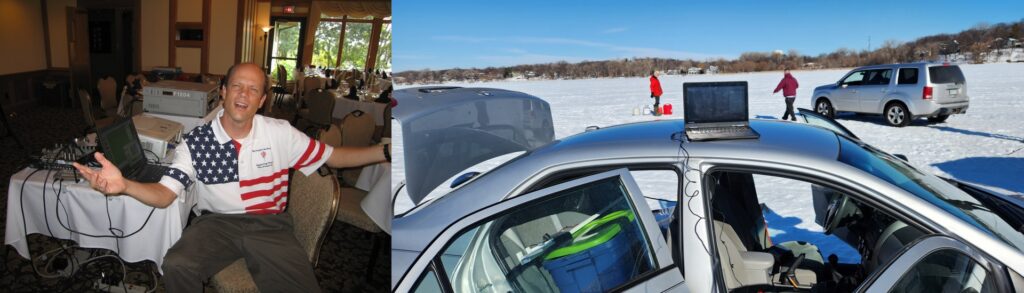
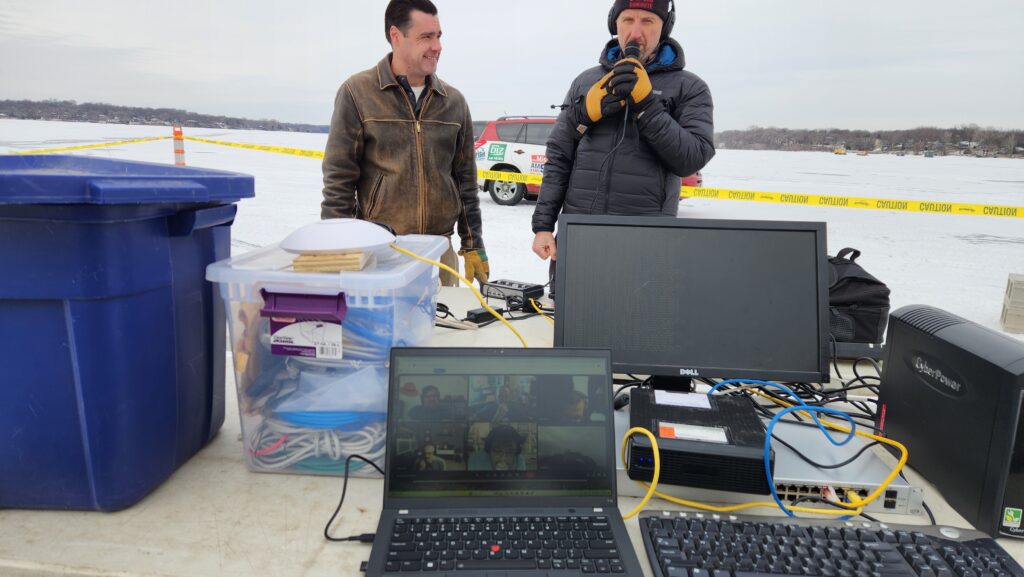
Long before Scott published books like Trafficking U, Virus Bomb, and Bullseye Breach, he worked as a solo IT professional, standing on golf courses and frozen Minnesota lakes to wage a private, exhausting war against the primitive internet infrastructure of the mid-2000s. He set out with a clear mission: build live, broadcast-quality video lifelines connecting deployed U.S. troops in Iraq, Afghanistan, and around the world with the families they left behind back home.
Scott laughs, recalling the early days of volunteering for organizations like Tee It Up for the Troops and Fishing For Life. "Many so-called experts told me it was impossible. But I never liked impossible. Some people called me stubborn. I like the word, persistent, better."
Engineering the Miracle
To understand the scale of Scott’s accomplishments, you have to rewind the digital clock to 2003. Long before Zoom, FaceTime, or 5G data networks existed, video conferencing required specialized, finicky hardware, rigid protocols, and massive, expensive corporate pipelines.
When Scott set out to create real-time video connections at charity events, he lacked a corporate budget or a team of engineers. He relied instead on his one-person enterprise infrastructure company, Infrasupport, a relentless DIY attitude, and a mountain of determination.
Undeterred by standard corporate brick walls, Scott bypassed the low-level gatekeepers and tracked down a dedicated sales rep at a hungry local telecom company. He pitched the vision until the rep pulled the right internal levers to secure two dedicated 1.544 Mbps T1 lines—one at Scott's house and one at his church.
In an era where a single dropped packet could destroy a video stream, Scott manually manipulated firewalls, wrestled with conflicting H.323 network standards, and forced the clunky hardware of the era to behave like a broadcast pipeline.
His technical expertise made it work, but his powers of persuasion yielded even greater victories. When a deployed father in Iraq faced missing the birth of his child, Scott stepped in. He convinced the hospital networking staff to modify their network to support the inbound video stream. Because Scott broke through that administrative wall, the father sat virtually inside the Minnesota hospital room, offering so much encouragement through a TV monitor as his wife gave birth that the nurse finally had to turn to the television and tell him to shut up.
Scott’s efforts echoed across the state. At a packed St. Paul Saints game on the Fourth of July, 2005, over 10,000 roaring fans looked up at the stadium's big screen to see and interact live with Marines stationed on the other side of the globe. At a Minnesota Twins game that same weekend, thousands of Major League baseball fans watched a dad on the big screen from Iraq wish his 12-year-old son, standing right on the pitcher's mound, a happy birthday. For eleven years at Mendakota Country Club, Scott held down the digital fort for Tee It Up for the Troops, ensuring that the heavy static of war zones never broke the fragile, vital connections between local families.
When Operations Pulls the Plug
The real test of Scott’s grit came about a year into the project, when his entire operational network suddenly went dark.
"Everything just stopped working with zero warning," Scott recalls. When he called to diagnose the catastrophic outage, he uncovered a classic case of corporate right-hand not talking to the left: The Marketing Department had sponsored the lines as a charitable endeavor but had never paid the Operations department for the infrastructure. Tracking a massive internal deficit, Operations simply pulled the plug without notifying Scott.
This mistake did not just threaten the charity events; it posed an existential threat to Scott's business. The sudden loss of his home T1 line meant his static management IP address vanished overnight. Instantly, every single corporate firewall protecting his paying clients across the region went blind to his remote access, locking him out of his own kingdom.
Faced with a compromised client management infrastructure, Scott did what he does best—he negotiated. He persuaded the provider to grant him a single week of temporary uptime, then entered a dead scramble. Working furiously against the clock, he provisioned a block of static IP addresses through a newly available DSL connection with the incumbent telecom carrier, manually updated the firewalls across his entire paying customer base to trust his new digital location, re-secured his business, and kept the lifelines alive.
Moving the Battle to the Cyber Thriller Author Page
Scott’s history represents more than a proud chapter of community service; it provides the raw fuel that powers his literary career as a cyber thriller author.
When cyber thriller author Scott writes about cybersecurity, network vulnerabilities, or high-stakes digital standoffs, he does not guess what a system on the verge of collapse feels like. He knows exactly how it feels when the pressure mounts, when the eyes of anxious military families stare at a blank screen, and the engineer has only seconds to find a workaround.
His protagonists mirror his own real-world grit—independent operators who must rely on their wits, fight through corporate complacency, and face down the cynics to protect what matters.
"Every bit of the tension in my books comes from real life," Scott says. "When you have to make a network work on top of three feet of ice in the dead of a Minnesota winter, or fight through military bureaucracy to find somebody to say yes to a family reunion, you understand the human side of technology."
For readers picking up a Greg Scott novel, the thrill extends beyond the fiction. They know that the cyber thriller author who wrote the book is the same guy who spent a decade quietly building bridges across the world, one firewall rule at a time.
Thanks Gemini!
If you want to find out more or are interested in volunteering with either of these organizations, contact me and I’ll hook you up with the right people.

Recent Comments