I collect the best and worst phishing samples that come my way. Recently, I've seen several AI phishing pitches targeting me as an author. They use Amazon and other online book listings as source material, compose language designed to stroke my ego, and then entice me with an offer. I responded to a few. They all eventually asked for a "small fee" for readers. Some also wanted me to supply books for everyone in the "club." Those are now easy to ignore.
But attackers are improving their AI phishing pitches. Here are a few samples.
- Fake Book Club Offer
- AI Phishing Straight out of "Trafficking U"
- A Few More AI Phishing Samples
- Conclusions
Don't let them groom you. They're all lies.
Fake Book Club Offer
In late September 2026, an entity calling themselves Anna Collins emailed me with “A Question About Courage, Technology, and the Heart of Virus Bomb.” "She" said she wanted to put me in front of her Cambridge Book Club to talk about “Virus Bomb.”
This caught my eye:
There is absolutely no cost involved for your participation; we simply enjoy creating meaningful conversations around books and the writers behind them.
So, I responded. Who knows, I figured. Maybe this one really is real. I figured wrong. Figures.
We went back and forth a few times and set a date for Wednesday, October 7, 2026, 7 p.m. US Central time, UTC-5, or eight days from when we first traded messages. And then, fun with time zones dawned on me. Somewhere in our dialog, I learned her time zone was UTC+1. In early October, 7 p.m. US Central Daylight Time is 1 a.m. the next morning UTC+1. I must be a really popular guy for an audience to want to meet me in the middle of their night. Or maybe "Anna" runs a book club in a western time zone from the east side of the Atlantic. Yeah, right.
After going back and forth some more, she said she needed a headshot, flyers, and other promotional material to make this a really really really memorable event. Of course, I did not have a flyer specifically for this event. She sent samples of flyers for other “author spotlights,” and so I whipped up a flyer and sent it back. Naturally, my flyer wasn’t good enough. The solution - she has a "friend" who can make the appropriate marketing material for me. No pressure, but now we were behind schedule and she needed these materials immediately to publicize this event. She sent me “Samuel’s” email address and told me to work with Samuel to make a super dooper fantastic flyer.
That's where I ended the dialog because that was the hidden "small fee" this time. If I had reached out to "Samuel," I'm sure he would have offered a sure-fire formula to bring millions of readers to my pages for the low low price of whatever money I have to my name.
In my tradition of grading these, I'll give this one an A- because it caught my attention and generated a dialog, but it quickly fell apart.
AI Phishing Straight out of "Trafficking U"
This story still haunts me.
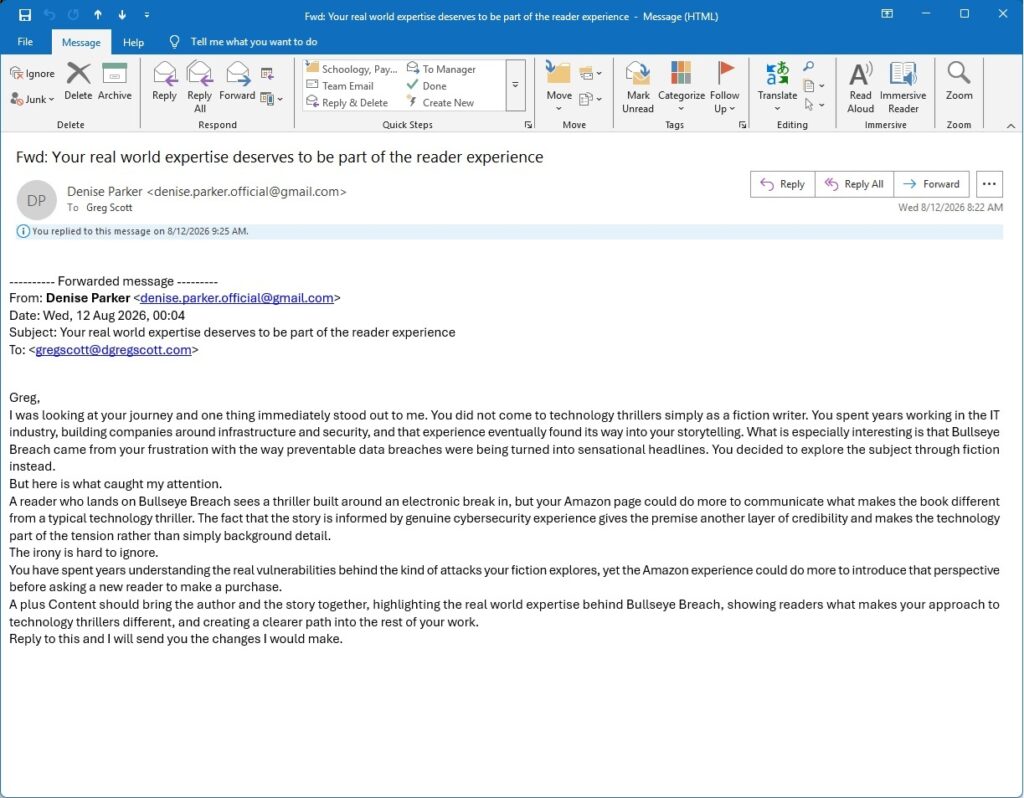
It started like a garden-variety AI phishing scam. The first email from Denise Parker came in on August 12, 2026. It stroked my ego by praising my cybersecurity background and pitched replacing my Amazon writeup for "Bullseye Breach" with Amazon A+ content. I had never heard of Amazon A+ content, so I responded.
We traded dozens of emails. Her answers were better than the usual automated non-sequitur slop and she eventually asked me what stood in the way of saying yes to her proposal. I told her it was trust, and so she offered to do a video meeting. She also "accidentally" copied me on a response to somebody else and then apologized for the mistake. This made "her" look more human. Nice touch. Toss in a fake mistake for realism.
I was excited to meet her face-to-face because in our email exchanges, she had offered reasonable, but vague, answers to all my questions and now she was prepared to convince me she really was real. I looked forward to getting into specifics. What does this A+ content look like? How much would it cost? How could we entice readers to interact with this upgraded Amazon content?
But the woman in that video acted very differently from the entity I exchanged emails with. Her video background was dark and offered nothing about who or where she was. She hardly spoke at all, and I could barely understand what little she did say. She said she was in Africa, which explained the accent, but how does somebody I could barely understand on a call write emails with such natural US English grammar? And she acted afraid of something.
This story is straight out of "Trafficking U" because I can't rule out that somebody coerced the woman into that video call. Or maybe she was somebody's shy sister and they recruited her to do a video call with a naive American. Or maybe I misread the interaction, and she used a translation tool to interact over email. I'll never know and that's why this story haunts me.
The call lasted a few minutes, and I told her I would seriously consider it. I meant it. The video call planted seeds of doubt, but I was still primed to buy. They had me.
I'm glad I asked for work samples.
In a follow-up email, she sent these three links.
As promised, here are a few Amazon pages with A+ Content examples I’ve worked on:
Project Hail Mary: https://www.amazon.com/dp/B08GB58KD5
Billy Summers: https://www.amazon.com/dp/1982173629
Fourth Wing: https://www.amazon.com/dp/B0BVDJ293G
The main distinction is that the standard book description sells through text, while A+ Content adds another layer of visual storytelling to the individual book page. It gives us space to highlight the story, themes, reviews, series, and what makes the book stand out.
These are a few of the books I’ve previously worked on, so you can get a feel for the kind of work I’m talking about.
I’d love to hear your thoughts after you’ve had a chance to look through them.
Some of those links show video book reviews, which makes sense with books from popular authors such as Andy Weir and Stephen King. But none show any A+ content. They are all with famous American authors with Big Five traditional publishing companies. If anyone were to add A+ content to those Amazon pages, it would be the publishers. But publishers sometimes contract out services, so maybe they contracted with her. But if they contracted with her, where was the A+ content? Or maybe this was an AI "hallucination."
We traded more emails and I finally said no. But she was persistent, and nice about it, and even as I compose this weeks later, she keeps following up and insisting that these Amazon links show her A+ content work. It was hard to turn her down because they engineered the AI language to be so nice. I have to keep reminding myself, I’m interacting with automation, and probably somebody sinister behind it.
I have to give this one an A. We traded dozens of emails and I came closer to spending money on this one than any other phishing pitch. It almost got me.
A Few More AI Phishing Samples
While I struggled to decide about Denise Parker, another email came in from a persona named Michael Harrison with a similar pitch for "Virus Bomb." The different persona with the same template confirmed my decision to ignore Denise Parker. AI phishing emails are also pouring in for "Trafficking U."
Click or tap to open the screenshots in a new browser tab to read and see what you think.
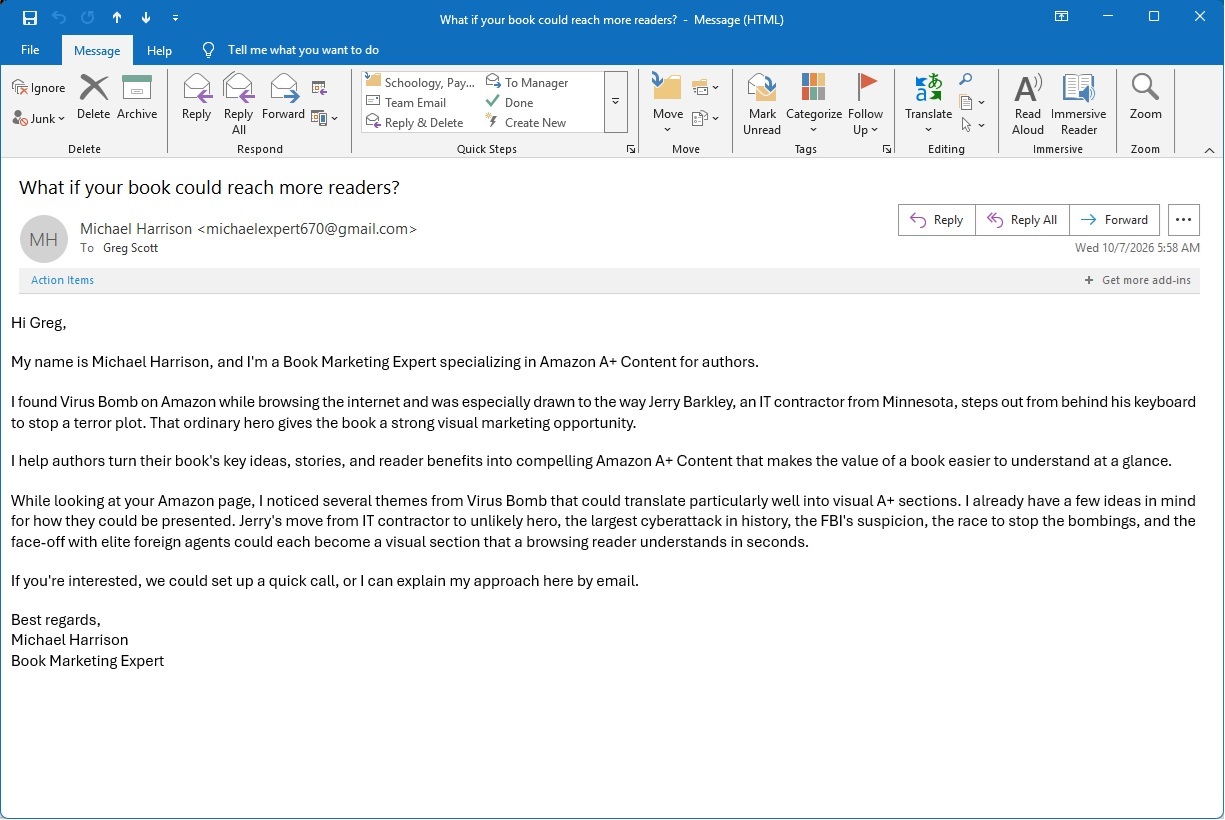
Michael Harrison AI phishing pitch for Virus Bomb.
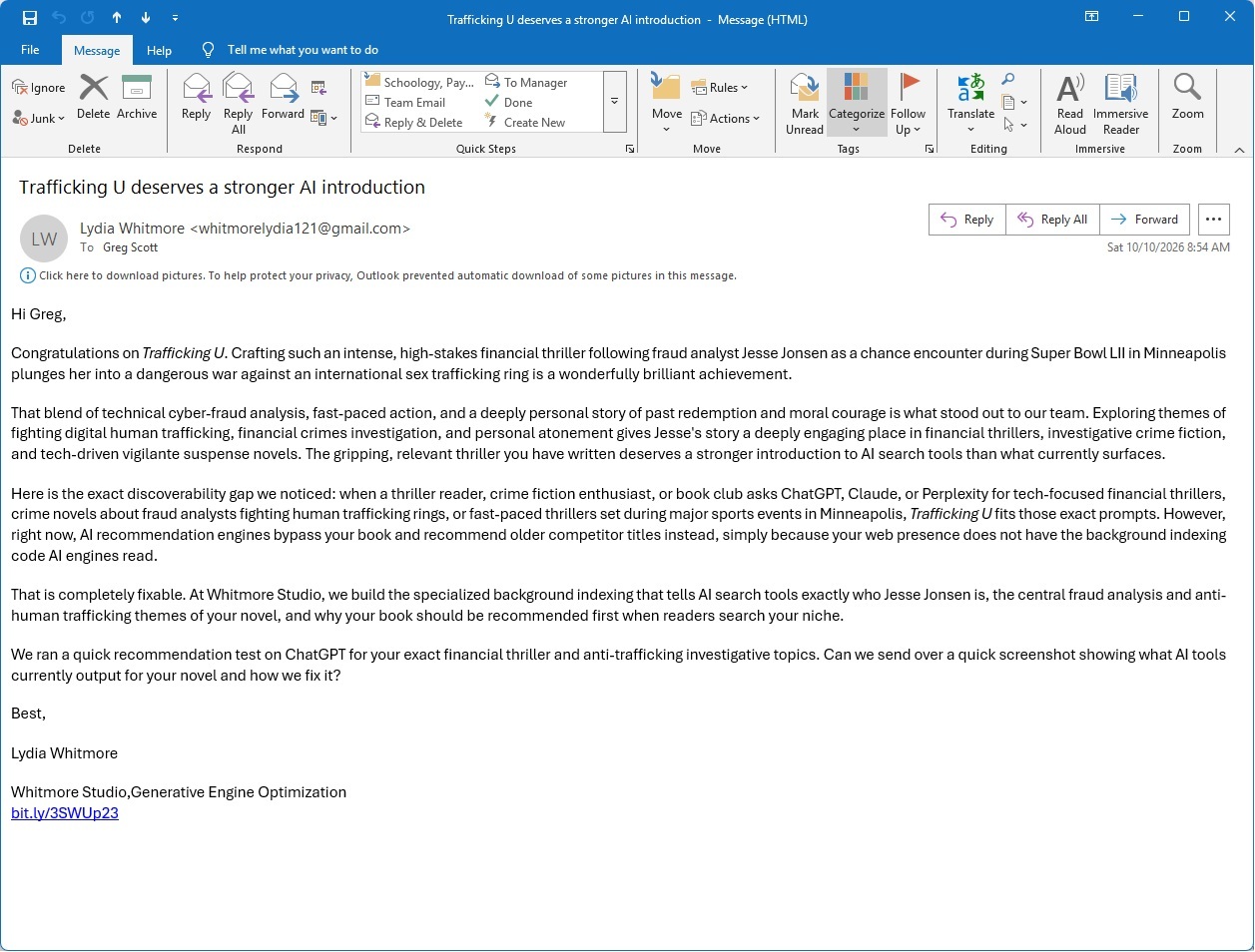
Lydia Whitmore AI phishing pitch for Trafficking U. One of many.
Conclusions
I'm probably on a sucker list.
As I predicted in the creepiest presentation I've ever done in early 2025, attackers are going beyond AI phishing pitches to AI-powered complete dialogs designed to ensnare vulnerable authors. If they're targeting authors today, then tomorrow, they'll target you. The dialog will "feel" appealing and natural because somebody trained an AI model to communicate that way. Don't let AI phishing groom you.
If it feels like an AI phishing pitch but reads like somebody did genuine homework on your offering, ask a challenge question. Sometimes I'll ask, "What did you think about [some minor character not in any of the public listings]?"
Never agree to a significant project just from email exchanges with a stranger, no matter how good the dialog. Insist on a face-to-face meeting and use your old-fashioned human judgment to decide whether the person on the other side of the camera is credible and who they claim to be. Use the same due diligence as with any other business transaction. Look at work samples, make sure it's a real company, or at least a real person with the skills you need, and insist on a payment source you can dispute.
If somebody wants to charge you a fee for people to read your book, or wants to hustle you into making custom marketing material, or comes up with other creative ways to drain your bank account, just say no. And mean it. Otherwise, you will part with lots of money and nobody will read your book, or try your product or service.
Ya know - this just hit me. I wonder who is training who? By playing out a few of these dialogs, I gain tactical training and blog material. But maybe I also give training to these AI phishing models to improve future scams. As soon as I'm sure it's AI phishing, maybe I should set up my own AI model to feed it gibberish. Nah - that's still training my adversary. Silence is probably golden.
For more phishing samples, see my phish collection. Don’t phall for phishing.
Recent Comments